

Challenges Faced by Women in the Social Care Workforce: A Focus on Gender and ‘Race’ Intersectionality in Training Reforms, with Emphasis on the 2023 English Social Care Sector. 31 March 2026
Challenges Faced by Women in the Social Care Workforce: A Focus on Gender and ‘Race’ Intersectionality in Training Reforms, with Emphasis on the 2023 English Social Care Sector. 31 March 2026
31 Mar, 2026
EventsNews
Webinars
United Kingdom (England)
Published:
03 Feb 2026
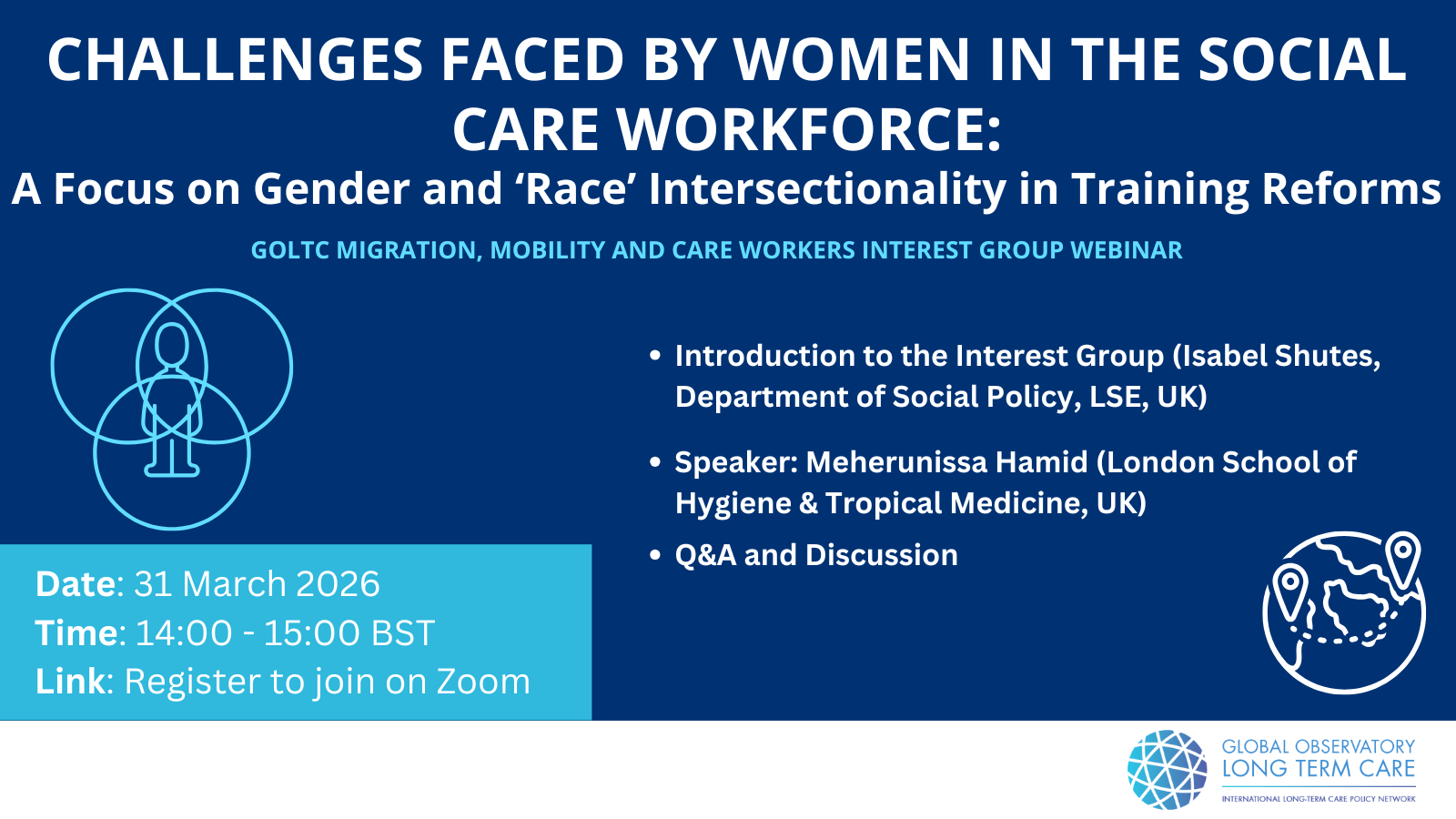
Challenges Faced by Women in the Social Care Workforce: A Focus on Gender and ‘Race’ Intersectionality in Training Reforms, with Emphasis on the 2023 English Social Care Sector
GOLTC Migration, Mobility and Care Workers Interest Group webinar
Date: 31 March 2026
Time: 14.00-15.00 BST, you can check your local time here.
Link: Register to join on Zoom.
In 2024, women made up 79% of the social care workforce in England. Their increased representation is due to historical gender roles and societal expectations that associate caregiving responsibilities with women. As a consequence, caring is presumed to come naturally to women and thus is often viewed as unskilled labour rather than being recognised as an acquired and valuable skill. This has led to limited policy level investment to improve the career progression and wellbeing of women in the social care workforce. This lack of investment has created pervasive challenges of poor pay, irregular working hours, precarious contracts, and the absence of standardised and limited training opportunities for women.
Following Brexit, the social care sector has increased its reliance on and recruited migrant workers from non-European Union countries, which has contributed to its growing ethnic diversity. In 2024, 32% of the workforce were migrant workers. Among those internationally recruited, only 2% were White compared to the 88% of domestically recruited social care workers. Minority ethnic and migrant women in the social care sector encounter additional challenges due to their gender and ‘race’ which lead to limited access to training and career advancement, as well as systemic racism that adversely affect their overall wellbeing at home and in the workplace.
This study utilised the 2023 adult social care workforce reforms, designed to create training opportunities and career pathways, as an example to understand whether the formulation of these reforms in a heavily feminised sector, addressed gender, ‘race’ and migration related challenges faced by women workers in the English social care sector. Social care workers, predominantly working in domiciliary care, who were women, comprising recent migrant workers to the UK and non-migrant workers, were interviewed for nuanced exploration of the social care workers’ lived experiences of training in the sector. The findings were analysed using an intersectional lens, particularly focusing on the interplay of gender and ‘race’.
The social care workers interviewed reported on the gendered burden of caregiving, inadequate training structures influencing their career development and the financial insecurity involved in working in the social care sector. The migrant women interviewed reported additional challenges of racism and discrimination by employers and clients, as well as the impact of immigration policies on their career progression and wellbeing. Overall, the findings suggest that formulation of the 2023 workforce policy reforms has been gender, ‘race’, and migrant blind, treating the workforce as a homogenous group and thereby reinforcing their invisibility and marginalisation. These reforms fail to address the intersectional nature of care work as both racialised and gendered.
The webinar will cover:
- Introduction to the Global Observatory of Long-Term care and welcome (Adelina Comas-Herrera, Care Policy and Evaluation Centre, LSE, UK)
- Introduction to the GOLTC Migration, Mobility and Care Workers Interest Group: Isabel Shutes (Department of Social Policy, LSE, UK)
- Challenges Faced by Women in the Social Care Workforce: A Focus on Gender and ‘Race’ Intersectionality in Training Reforms, with Emphasis on the 2023 English Social Care Sector, Meherunissa Hamid (London School of Hygiene & Tropical Medicine, UK)
- Discussion: Isabel Shutes