

Webinar: Can AI Understand Meaning? Exploring LLMs in Qualitative Research. 10 December 2025
Webinar: Can AI Understand Meaning? Exploring LLMs in Qualitative Research. 10 December 2025
10 Dec, 2025
Events
Published:
08 Sep 2025
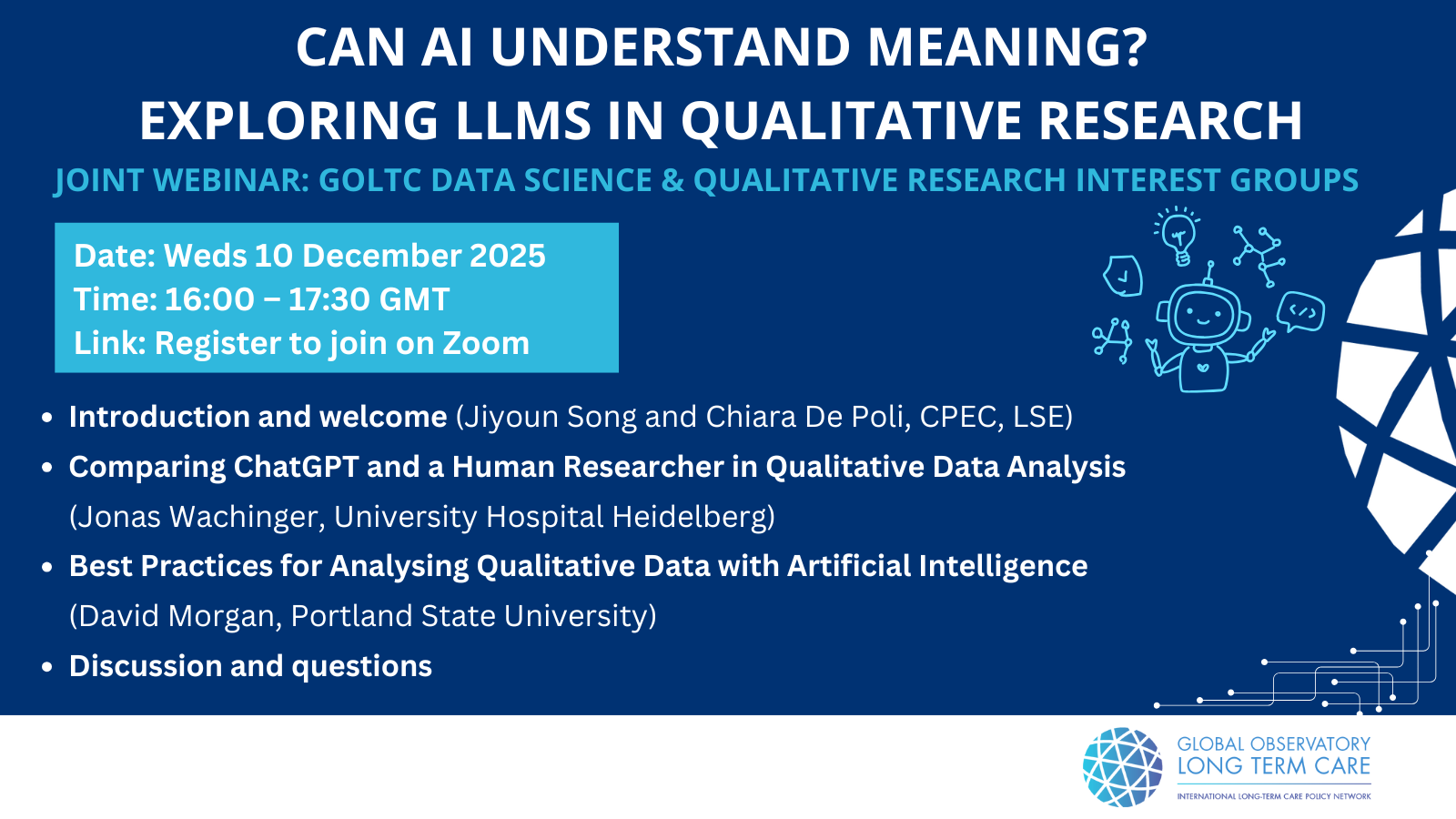
Can AI Understand Meaning? Exploring LLMs in Qualitative Research
GOLTC Qualitative Research and Data Science Interest Group webinar
Date: 10 December 2025
Time: 16:00 – 17:30 GMT (you can check your local time here.)
Link: Register to join on Zoom
What happens when AI tries to do qualitative research? This webinar brings together two researchers who used ChatGPT to analyse qualitative data – testing its ability to identify themes, generate codebooks, and engage with theory. Their work offers practical insights into what these tools can do, where they struggle, and what it means for the future of qualitative analysis.
As language models become more widely used, they raise questions about rigour, transparency and ethics. How effective are these tools? How much time can they save? What risks do they pose?
Join us for this session about the benefits and challenges of using and evaluating AI in qualitative research.
The webinar will cover:
1. Introduction to the Global Observatory of Long-Term care and welcome (Adelina Comas-Herrera, Care Policy and Evaluation Centre, LSE, UK).
2.Introduction to the two GOLTC Interest Groups hosting the webinar, the Data Science Interest Group (Dr Jiyoun Song, Department of Biobehavioral Health Sciences, University of Pennsylvania School of Nursing) and the Qualitative Research Interest Group (Dr Chiara De Poli, Care Policy and Evaluation Centre, London School of Economics and Political Science)
3. Presentation by Jonas Wachinger (Heidelberg Institute of Global Health, University Hospital Heidelberg, Germany), “Comparing ChatGPT and a Human Researcher in Qualitative Data Analysis”
4. Presentation by David Morgan (Department of Sociology, Portland State University) “Best Practices for Analysing Qualitative Data with Artificial Intelligence”
5. Discussion: Jiyoun Song (Department of Biobehavioral Health Sciences, University of Pennsylvania School of Nursing) and Chiara De Poli, (Care Policy and Evaluation Centre, London School of Economics and Political Science)