

WHO invites your input on the first Global Standards for Long-Term Care — public consultation open until 30 October 2026
WHO invites your input on the first Global Standards for Long-Term Care — public consultation open until 30 October 2026
Published:
21 Sep 2026
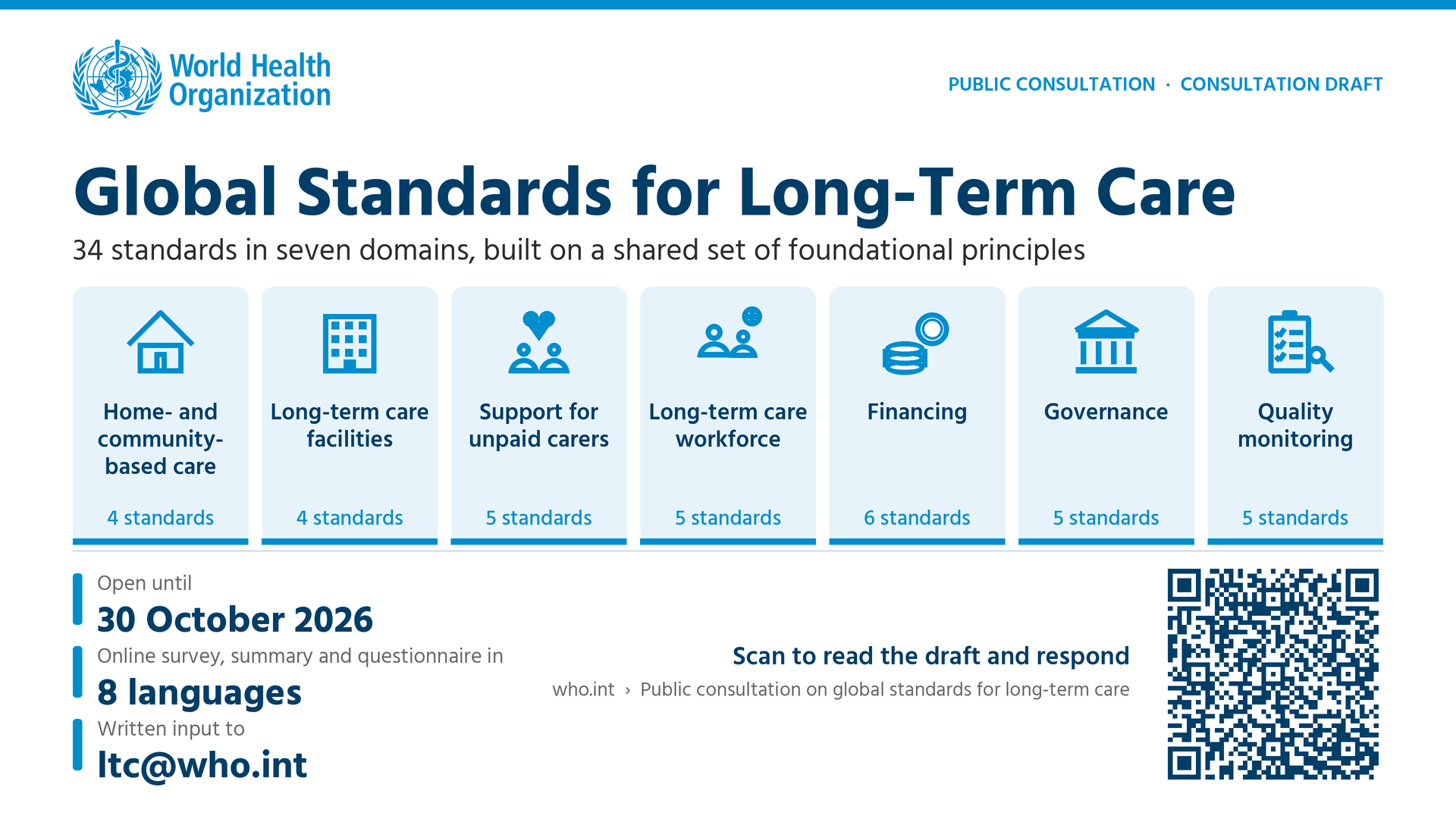
The World Health Organization is calling for input on the consultation draft of its Global Standards for Long-Term Care, the first WHO document to set out what a quality long-term care system should look like across all settings, from home- and community-based care to residential facilities. GOLTC members are warmly invited to contribute.
What the standards are
The draft was released at the Seventy-ninth World Health Assembly in May 2026. It opens with a set of foundational principles that apply across all domains, followed by 34 standards organized in seven chapters: home- and community-based care; long-term care facilities; support for unpaid carers; the long-term care workforce; financing; governance; and quality monitoring. Each standard is expressed through quality statements, with a rationale, implementation guidance and indicative measures. The standards are written as a framework for adaptation rather than a rigid template, and the draft illustrates how they can be applied by countries at different stages of long-term care system development.
The document is a working draft for public consultation and is not for citation. Once the consultation closes, WHO will synthesize the input received and revise the draft, with finalization planned during 2027.
Why your input matters
GOLTC brings together researchers and practitioners with detailed knowledge of how long-term care systems actually work — and where they fall short — across a wide range of countries. That is exactly the evidence this consultation needs. WHO is particularly interested in views on whether the standards are relevant and feasible across different contexts, whether anything important is missing or wrongly framed, whether the indicative measures are useful for national monitoring, and what would make the standards most useful for policy, practice and research in your setting. Comments on individual chapters or standards are as welcome as comments on the document as a whole.
How to respond
- Read the full consultation draft (English) and the summary, available in Arabic, Chinese, English, French, Korean, Portuguese, Russian and Spanish, on the consultation page: https://www.who.int/news-room/articles-detail/call-for-public-consultation-on-global-standards-for-long-term-care
- Respond through the online survey, available in the same eight languages: https://extranet.who.int/dataformv6/index.php/947261 (you may complete only the parts relevant to you)
- Alternatively, send written comments, a completed questionnaire or a position paper to ltc@who.int
- Organizations are encouraged to submit a consolidated institutional response; individual responses are equally welcome.
Deadline: 30 October 2026
WHO is also glad to co-organize dedicated consultation sessions with networks and institutions. For questions, please contact jangh@who.int.