

Empowering continence care: education for residents and families. 28 October 2026
Empowering continence care: education for residents and families. 28 October 2026
28 Oct, 2026
EventsWebinars
Published:
14 Jul 2026
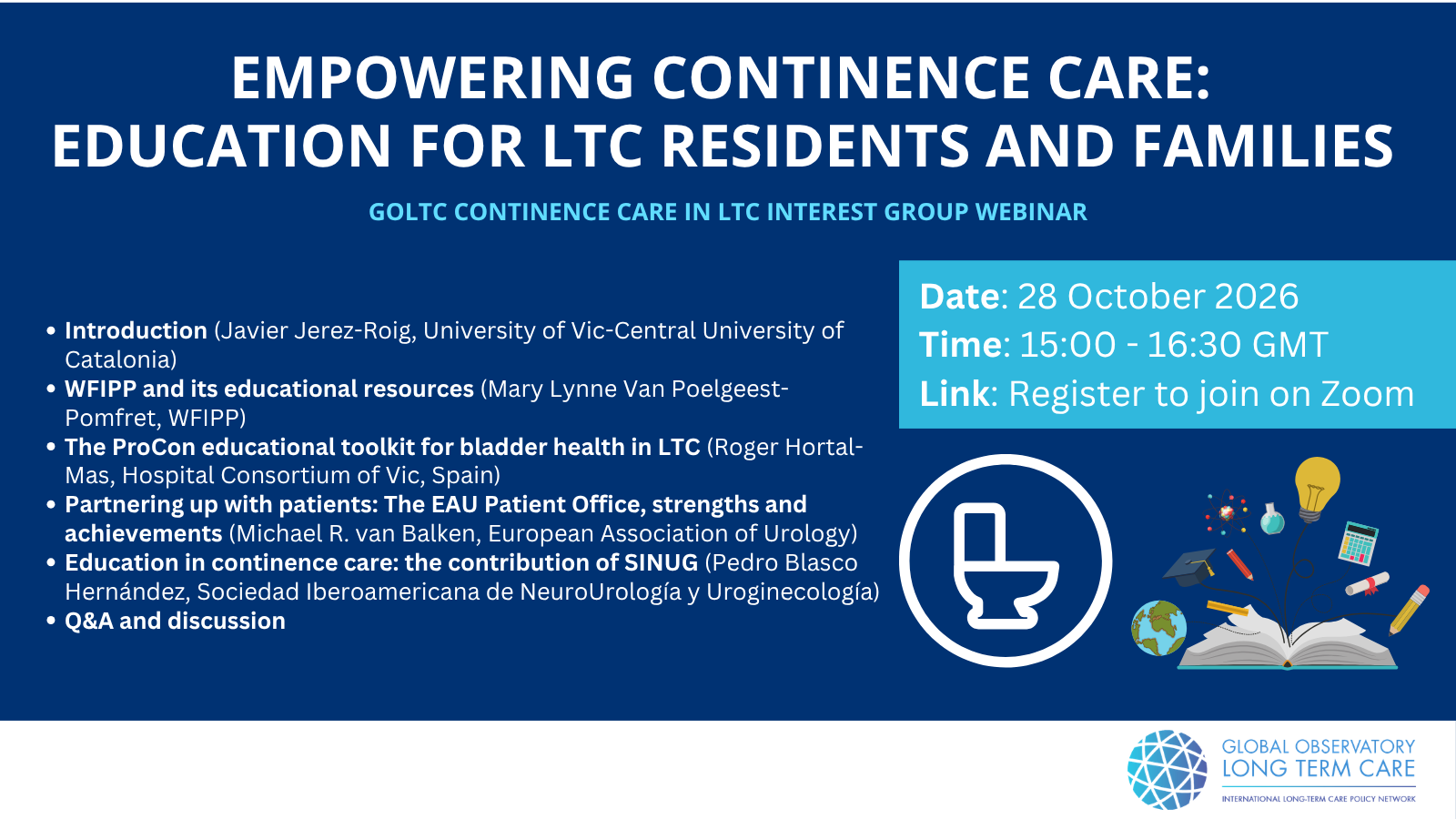
Empowering continence care: education for residents and families
GOLTC Continence Care in long-term care Interest Group Interest Group webinar
Date: 28th October 2026
Time: 16.00 CET / 15.00 BST to 17:30 CET / 16:30 GMT (you can check your local time here.)
Link: Register to join on Zoom
This webinar will explore how education can empower residents and families to take an active role in continence care within long-term care settings. Drawing on evidence-informed approaches and international educational initiatives, speakers will present practical tools, resources, and strategies to enhance knowledge, build confidence, and support shared decision-making in everyday care.
The session will highlight how tailored education can promote behaviour change, strengthen communication between residents, families, and care teams, and reinforce dignity, autonomy, and well-being. Participants will gain actionable insights into engaging families as partners in care, adapting educational approaches to diverse needs, and fostering supportive environments that enable improved bladder health and continence outcomes.
Whether you are a clinician, researcher, educator, or policymaker, this webinar offers practical guidance and inspiration to advance person-centred, education-driven continence care.
The webinar will cover:
- Introduction to the Global Observatory of Long-Term care and welcome (Adelina Comas-Herrera, Care Policy and Evaluation Centre, LSE, UK)
- Introduction to the Continence Care in long-term care GOLTC Interest Group (Javier Jerez-Roig, University of Vic-Central University of Catalonia-UVic-UCC, Lithuanian Sports University-LSU)
- Presentations:
- WFIPP and its educational resources (Mary Lynne Van Poelgeest-Pomfret, World Federation of Incontinence and Pelvic Problems)
- The ProCon educational toolkit for bladder health in long-term care (Roger Hortal-Mas, Hospital Consortium of Vic, Spain)
- Partnering up with patients: The EAU Patient Office, its strengths and achievements (Michael R. van Balken, European Association of Urology)
- Education in continence care: the contribution of SINUG (Pedro Blasco Hernández, Sociedad Iberoamericana de NeuroUrología y Uroginecología – SINUG)
- Q&A and discussion (Javier Jerez-Roig, UVic-UCC, LSU)