

By Yeeun Lee1, David Knapp1, Beatrice Fabiani de Leva2, Heber Dávila3 and Ludovico Carrino4.
1University of Southern California 2Inter-American Development Bank, 3Ca’ Foscari University of Venice, 4University of Trieste
This blog is a complement to a perspective recently published in the Journal of Long-Term Care: https://doi.org/10.31389/jltc.487
Introduction
By 2050, the global population aged 60 and over is projected to more than double, reaching roughly 2 billion (United Nations, 2017). In some countries, older adults already make up a significant share of the population. For example, 29% of Japan’s population is over 65, followed by Italy, Portugal, and Greece at 23–24% (OECD, 2025). Similarly, the US and the UK are also experiencing rapid population aging: between 2022 and 2050, the number of adults aged 65 and older in the US is projected to grow by 41% (from 58 million to 82 million), while the UK is projected to see a 74% increase between 2022 and 2072 (from 12.7 million to 22.1 million) (Population Reference Bureau, 2024; UK Parliament, 2024).
Populations are not ageing as healthily as they could, leading to a growing demand for long-term care (LTC) as more people need help with daily activities for longer periods (OECD, 2025). Projections indicate that the number of individuals in need of LTC in the European Union will rise from 30.8 million in 2019 to 38.1 million in 2050, representing an increase of approximately 24% (European Commission, 2021). The economic relevance of this issue is clear: informal carers provide the majority of LTC, and the value of their contribution exceeds public LTC spending in most countries (Costa-Font and Vilaplana-Prieto, 2025); yet, caregiving often limits labor market participation and affects carers’ health, with implications for economic growth (Cylus et al., 2025; OECD, 2025). At the same time, governments face fiscal constraints that make it difficult to expand LTC provision.
Across countries, LTC policies vary in eligibility requirements, coverage, and the types of care provided. Differences in eligibility, service availability, and the range of benefits all influence access to care and the experiences of those who rely on it. By examining how countries design and deliver care, it is possible to identify different strategies, highlight potential gaps, and inform policies to better address the needs of aging populations requiring LTC or experiencing care dependency, and their caregivers.
Despite the availability of policy information at the national level, detailed data on LTC benefit eligibility based on individual and household characteristics is lacking. Such data is necessary to determine who qualifies under a country’s policy and is a prerequisite for evaluating current and alternative LTC approaches. The Gateway Policy Explorer addresses this gap by systematically collecting national-level and state-level public LTC policies across the world (Avendano et al., 2026). This resource enables the determination of an individual’s coverage, benefit eligibility, and benefit amount based on personal circumstances, as well as any changes that may occur over time with evolving policy.
The Gateway Policy Explorer
The Gateway to Global Aging Data (‘Gateway’) is a data and information platform developed to facilitate longitudinal and cross-country analysis on ageing, particularly those using the Health and Retirement Study (HRS) and its International Network of Studies (HRS-INS) (Lee et al., 2021). The HRS began in 1992 as a nationally representative, longitudinal, multidisciplinary survey of individuals over age 50 in the US. Since then, it has been fielded every 2 years to maintain a nationally representative sample over time. As populations age around the world, the HRS prompted the development of comparable surveys in other countries, including:
- English Longitudinal Study of Ageing (ELSA)
- Survey of Health, Ageing and Retirement in Europe (SHARE)
- Northern Ireland Cohort for the Longitudinal Study of Ageing (NICOLA)
- Irish Longitudinal Study on Ageing (TILDA)
- Korean Longitudinal Study of Aging (KLoSA)
- Japanese Study of Aging and Retirement (JSTAR)
- China Health and Retirement Longitudinal Study (CHARLS)
- Longitudinal Aging Study in India (LASI)
- Mexican Health and Aging Study (MHAS)
These surveys share core features: population-representative samples of older adults, longitudinal design, multidisciplinary data, coordinated instruments, enhanced economic information, and integrated biomarkers. All HRS family studies make their data publicly available to the research community.
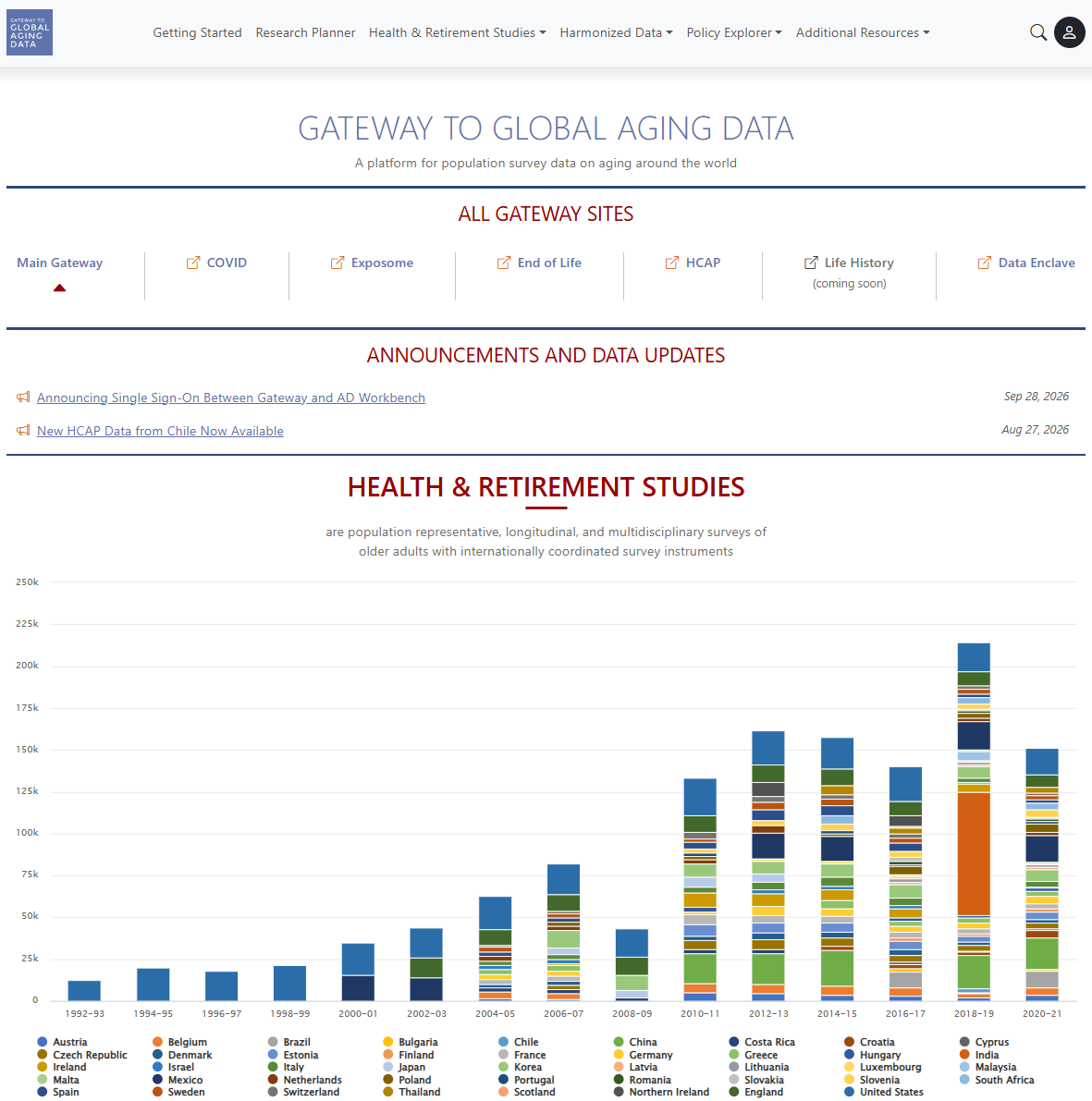
The HRS is over 30 years old, and many of the HRS-INS cover more than two decades. Because policies are constantly evolving, understanding the policy in place at the time a survey was conducted has become more demanding for researchers. Therefore, comprehensive, harmonized, country and state-level historical policy information has largely been missing as a resource for researchers using HRS and HRS-INS data. Where resources exist, they often provide insufficient detail to judge the applicability of a policy to a specific person and, in the case of public benefit and insurance programs, benefit eligibility or the amount of the benefit a person would be entitled to. The Gateway Policy Explorer fills these gaps, providing detailed information on LTC, retirement, and education policies alongside the nationally representative HRS-INS data, helping researchers understand how policy affects relevant populations.
The Gateway Policy Explorer LTC Series
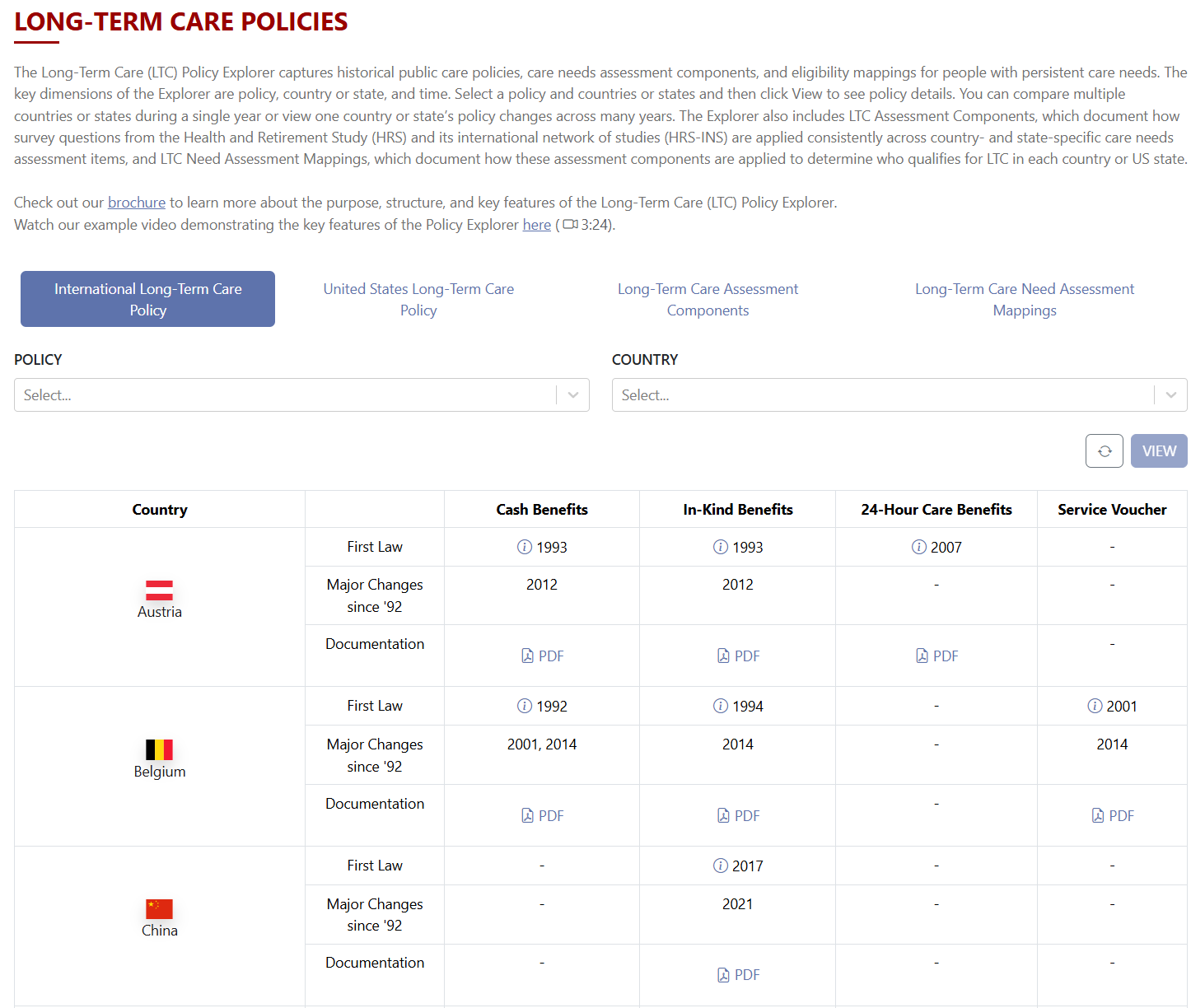
The Gateway Policy Explorer’s LTC Series includes detailed country and US state-level information across four policy types: cash benefits, in-kind benefits, 24-hour benefits, and service vouchers. For each policy type, a white paper is produced that describes eligibility requirements, the process for assessing care needs, the range of benefits, any limitations on those benefits, and the financing mechanisms. To date, the LTC Series has covered 22 countries and 37 US states for a total of 78 policy documents across the four policy types. The documents use standardized terminology and organization where possible, enabling comparisons across countries or states at a given time, or within a country or state over time. Observing policy at this scale can reveal major shifts and trends in LTC, capture differences across systems, and identify factors that may influence care trajectories and decision-making among older adults.
The Gateway Policy Explorer provides a comprehensive overview of LTC policies across countries and US states. An important aspect of how these policies function in practice is the use of care needs assessments and minimum thresholds, which determine access to benefits and the level or amount of services provided. Care needs assessments are designed to evaluate an individual’s requirements for support and assistance. However, the criteria used vary significantly across systems. Definitions of need may incorporate factors such as activities of daily living (ADLs), instrumental activities of daily living (IADLs), cognitive function, mobility, or various groupings of these elements. In some countries, the definition of need may also include factors beyond functional and cognitive limitations, such as the availability of existing care resources (e.g., informal care). Variations exist not only in the criteria considered but also in the approach to assessment. Some systems employ complex algorithmic models, while others rely on more straightforward methods. The scope of activities assessed can also differ, with some frameworks covering an extensive set of activities and others focusing on a narrower selection.
Additionally, care needs assessments often include minimum thresholds that individuals must meet to receive benefits. These thresholds may involve a required assessment score, a minimum number of care hours, or a specified level of need. They play an important role in determining who qualifies for support and how much care is provided. In general, a lower threshold means more people qualify and receive services, while a higher threshold means fewer people are eligible and receive support. The design of these thresholds can significantly affect both access and adequacy. For instance, systems that focus exclusively on physical limitations such as ADLs may fail to account for individuals with cognitive impairments or other non-physical challenges.
Cross-System LTC Needs Assessments
The Gateway Policy Explorer allows users to examine cross-national differences in LTC policies, including how care needs assessments and eligibility thresholds are applied. Broadly, LTC systems can be categorized into unified care frameworks and multiple targeted systems. Unified care frameworks operate through a single program that covers the full range of LTC needs. Countries such as Korea exemplify this model, offering centralized support through their Long-Term Care Insurance (LTCI) system. In contrast, multiple targeted systems rely on separate programs to address different levels or types of need. For example, in England, cash benefits provide support for basic care needs, while social care services address more complex requirements. In the US, institutional care and home and community-based services (HCBS) serve individuals who require a nursing facility level of care, while personal care services, which are less common, provide support for those with lower levels of care needs.
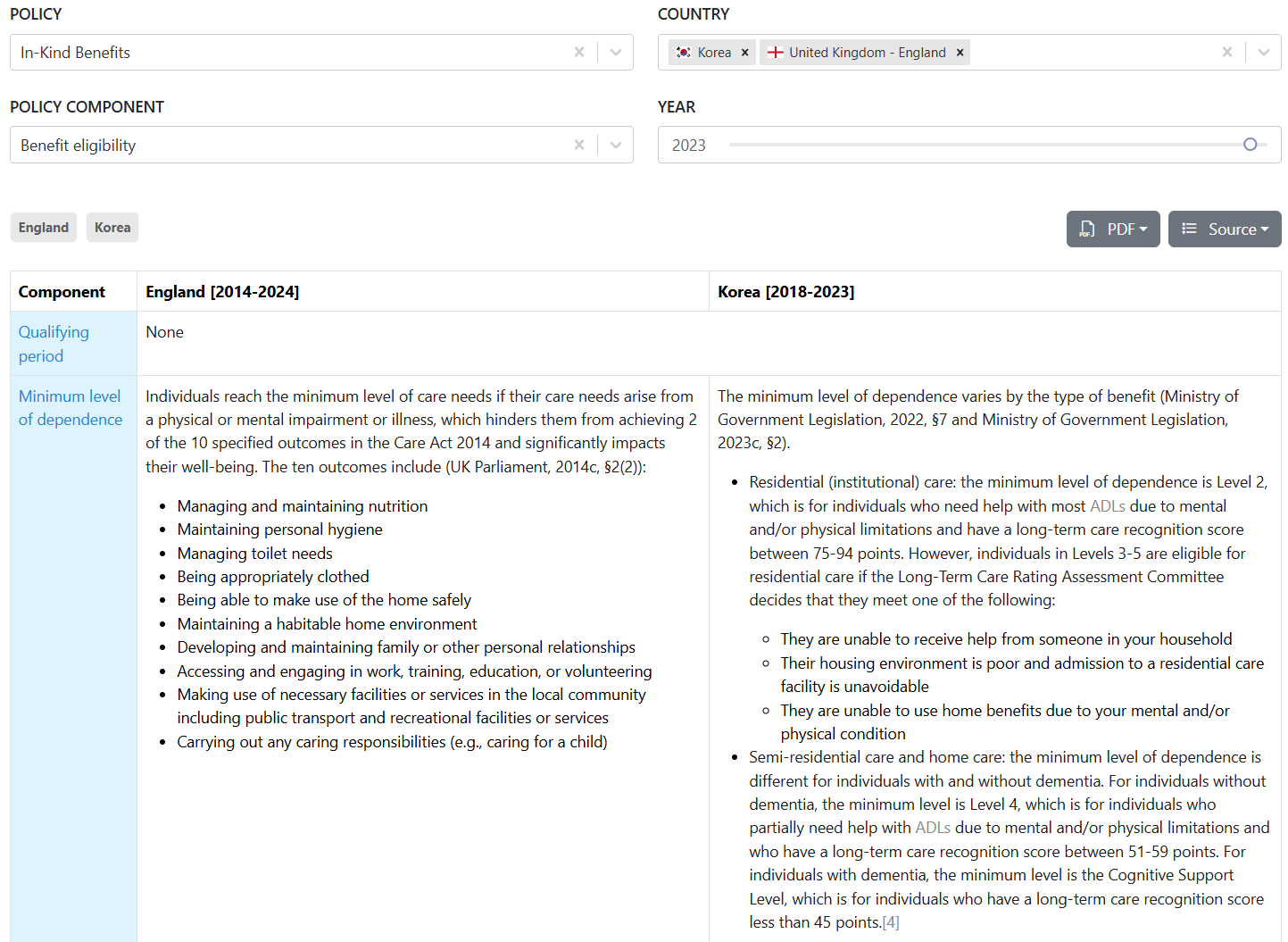
In Korea, all LTC services, including home care, community care, residential care, and cash benefits, are delivered through a single LTCI system. Because services are integrated under one program, a unified and standardized care needs assessment is used to determine eligibility. The assessment includes 52 items across five domains, with scores converted to a 100-point scale. Combined with item responses, these scores feed into a decision tree that estimates required care time and produces scores in eight domains. The scores generated across the eight domains are summed to produce the applicant’s LTC recognition score, which determines their level of care needs. Minimum care needs levels for LTC benefits in Korea vary by service type.
Conversely, in England, cash benefits such as the Attendance Allowance (AA) and in-kind benefits provided through social care services are administered through separate systems. For AA, eligibility assessments rely on reports from the applicant and caregiver, without a standardized scale or scoring rubric. Individuals qualify for AA if they meet the criteria for the lower rate, which includes either daytime or nighttime care needs. Daytime needs involve requiring frequent attention or continual supervision to avoid substantial danger. Nighttime needs involve either prolonged assistance or repeated help to ensure safety. Separately from AA, adult social care in England is administered by local authorities, so the type and range of benefits vary. There is some statutory guidance on evaluating care needs but no specific scales or scoring systems, leading to variation across authorities. To qualify for support, individuals must meet a minimum threshold: a physical or mental impairment or illness must prevent them from achieving at least two of ten specified outcomes, with a significant impact on well-being.
Similarly, the US provides LTC through multiple targeted programs, each serving distinct populations. Most LTC services are funded by Medicaid, a federally supported, means-tested health insurance program administered by individual states. States have considerable discretion in structuring their Medicaid programs, leading to variation in eligibility criteria, covered populations, and available services. While all state Medicaid programs are required to provide institutional care for individuals meeting the nursing facility level of care (NFLOC), most HCBS programs are offered through optional 1915(c) waiver programs, which also require NFLOC eligibility. In addition, some states operate personal care services programs to support individuals with daily living needs outside institutional settings. Since each state independently determines eligibility for NFLOC and personal care programs, the criteria, assessment methods, and minimum thresholds for accessing services vary considerably. Comprehensive information on NFLOC, 1915(c) waiver programs, and personal care programs is available here, with a shorter but still detailed comparison provided here https://doi.org/10.31389/jltc.487.
For further detail on how the Gateway has begun to harmonize these varied care needs assessments, linking country- and state-specific assessment criteria to standardized survey measures, see our related blog post on the LTC harmonization process.
Conclusion
Policies regulating LTC services for individuals with care needs have evolved substantially over the past thirty years. The Gateway Policy Explorer’s LTC Series provides a detailed record of policy variation across and within countries and US states, supporting research on LTC access and use. A central feature of these policies is the design of care needs assessments, including the use of minimum thresholds that determine both eligibility and the level of support provided. Linking these policy details with longitudinal, person-level data enables researchers to examine how differing definitions of care need and threshold rules shape who receives services, the type and amount of support provided, and subsequent care outcomes as eligibility rules change over time. By making policy differences visible and comparable, the Gateway Policy Explorer helps researchers and policymakers examine how specific rules may influence access to care and outcomes across settings. This evidence can support policy design by clarifying the implications of different approaches to eligibility and care provision.
Suggested citation
Lee, Y., Knapp, D., Fabiani de Leva, B., Dávila, H., Carrino, L. (2026) Understanding Long-Term Care Around the World: A New Policy Resource. GOLTC Blog, Global Observatory of Long-Term Care, Care Policy and Evaluation Centre, London School of Economics and Political Science. 10.5281/zenodo.23315310. https://goltc.org/publications/understanding-long-term-care-around-the-world-a-new-policy-resource/