

Defining quality in continence care for older adults. 13 May 2026
Defining quality in continence care for older adults. 13 May 2026
13 May, 2026
EventsNews
Webinars
Published:
12 Mar 2026
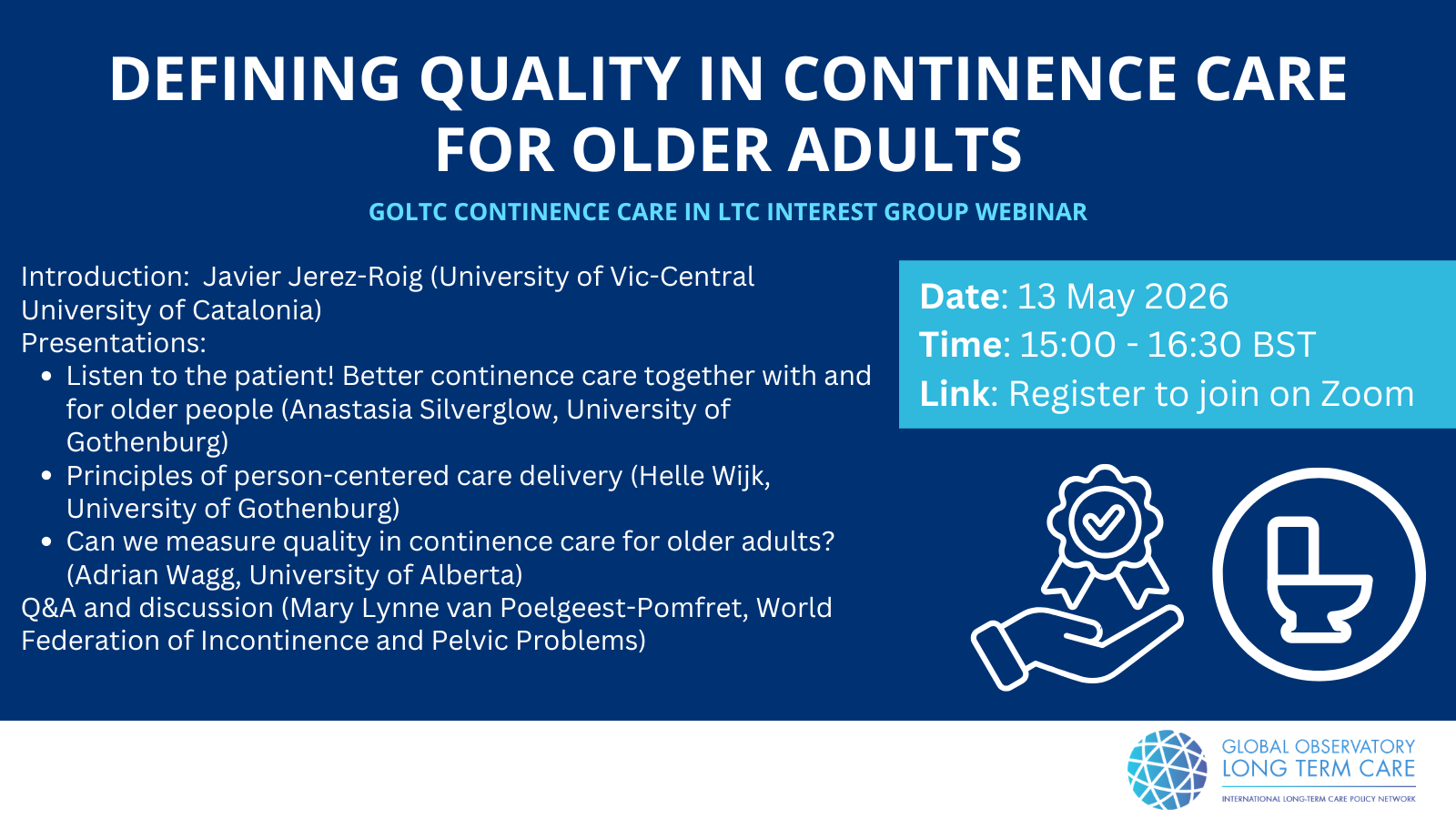
GOLTC Continence Care in long-term care Interest Group
Date: 13 May 2026
Time: 15.00 to 16.30 BST (you can check your local time here)
Link: register in zoom
This webinar will explore how person‑centered principles can enhance the quality of continence care in long‑term care settings, emphasizing dignity, autonomy, and individualized support. Leading experts will share evidence‑informed approaches, practical strategies, and real‑world examples illustrating how to meaningfully engage residents in assessment, decision‑making, and daily continence care routines. Participants will gain actionable insights into improving communication, tailoring interventions to varied cognitive and physical needs, and fostering care environments that place each resident’s preferences and well‑being at the forefront. Whether you are a clinician, researcher, educator, or policymaker, this session offers concrete guidance and inspiration for elevating continence care through a compassionate, person‑centered lens. Join us to learn, reflect, and work together toward advancing respectful, high‑quality continence care across long‑term care systems.
This webinar will cover:
- Introduction to the Global Observatory of Long-Term care and welcome (Adelina Comas-Herrera, Care Policy and Evaluation Centre, LSE, UK).
- Introduction to the Continence Care in long-term care GOLTC Interest Group (Javier Jerez-Roig, University of Vic-Central University of Catalonia)
- Presentations:
- “Listen to the patient! Better continence care together with and for older people.” (Anastasia Silverglow, University of Gothenburg, Sweden)
- “Principles of person-centered care delivery”. (Helle Wijk, University of Gothenburg, Sweden)
- “Can we measure quality in continence care for older adults?” (Adrian Wagg, University of Alberta, Canada)
- Q&A and discussion (Mary Lynne van Poelgeest-Pomfret, World Federation of Incontinence and Pelvic Problems)
Recommended reading:
Incontinence 7th Edition. Cardozo, L, Rovner, E, Wagg, A, Wein, A, Abrams, P. (Eds) Incontinence 7th Edition (2023). ICI-ICS. International Continence Society, Bristol UK, ISBN: 978-0-9569607-4-0. https://www.ics.org/ici
Farrés-Godayol P, Jerez-Roig J, Minobes-Molina E, et al. Urinary incontinence and sedentary behaviour in nursing home residents in Osona, Catalonia: protocol for the OsoNaH project, a multicentre observational study. BMJ Open 2021;11:e041152. doi:10.1136/bmjopen-2020-041152
Amblàs-Novellas, J, CollPlanas, L, Jerez-Roig, J, López, D, Martori, JC, Ramon-Aribau, A, Comas-Herrera, A, MorenoMartin, P, Solé-Casals, M, MáizMazuela, C, Masó-Aguado, M and Gómez-Batiste, X. 2024. Evaluation of the Impact of the Covid-19 Pandemic on People and Organisations in Long-Term Care Facilities of Catalonia and Proposals for Improving the Care Model: The Resicovid-19 Project. Journal of Long-Term Care, (2024), pp. 1–13. DOI: https://doi.org/10.31389/jltc.213
Boosting innovation, entrepreneurship and training for PROmoting CONtinence in nursing homes. https://goltc.org/projects/goltc-1738179296/
Michelle C Gao Saima Rajabali, Adrian Wagg To What Extent are Alberta Nursing Homes and Supportive Living Facilities Integrated with Their Community? A Sequential Quantitative-Qualitative Study Can Geriatr J. 2025 Mar 1;28(1):53-66. doi: 10.5770/cgj.28.783. eCollection 2025 Mar.
Marina Kirillovich, Saima Rajabali, Adrian Wagg Exploring the Priorities of Older Adults in Managing Urinary Incontinence: a Patient-Oriented Research Approach Can Geriatr J 2024 Dec 1;27(4):473-484. doi: 10.5770/cgj.27.758. eCollection 2024 Dec.
Katharina Abraham, Tim Andre Kanters, Adrian Stuart Wagg Nicole Huige, Edward Hutt, Maiwenn Johanna Al Benefits of a digital health technology for older nursing home residents. A de-novo cost-effectiveness model for digital health technologies to aid in the assessment of toileting and containment care needs PLoS One. 2024 Jan 2;19(1):e0295846. doi: 10.1371/journal.pone.0295846. eCollection 2024.
Muyibat Omotunde, Adrian Wagg Technological Solutions for Urinary Continence Care Delivery for Older Adults: A Scoping Review J Wound Ostomy Continence Nurs. 2023 May-Jun;50(3):227-234. doi: 10.1097/WON.0000000000000965. Epub 2023 Mar 1.
Saima N Rajabali, Kathleen F Hunter, Prosper Asaana, Megan L McCreary,, Sahar Nazari, Adrian S Wagg Effectiveness of a Smart Urinary Continence Care Assessment System for Nursing Home Residents: A Quasi-Experimental, Sequential Quantitative-Qualitative Methods Trial J Wound Ostomy Continence Nurs. 2023 Jan-Feb;50(1):48-56. doi: 10.1097/WON.0000000000000937.
Strauven, H., Wang, C., Hallez, H., Abeele, V.V., Vanrumste, B. with Strauven, H. (corresp. author) (2024). Unobtrusive Nighttime Movement Monitoring to Support Nursing Home Continence Care: Algorithm Development and Validation Study. JMIR NURSING, 7, Art.No. ARTN e58094. doi: 10.2196/58094
Strauven, H., Spiel, K., D’Haeseleer, I., Hallez, H., Vanrumste, B., Vanden Abeele, V. (2020). From Promoting Dignity to Installing Distrust: Understanding the Role of Continence Care Technology in Nursing Homes. In: 11th Nordic Conference on Human-Computer Interaction: Shaping Experiences, Shaping Society, (Paper No. 38). Presented at the NordiCHI ’20, Tallinn, Estonia, 25 Oct 2020-29 Oct 2020. ISBN: 978-1-4503-7579-5. doi: 10.1145/3419249.3420104
Wagg A, Agholme F, Schweigel H, Huige N, Hayder-Beichel D.(2025) A post-market, cluster randomised controlled trial of the effect of the TENA SmartCare Change Indicator on continence care efficiency and skin health in nursing homes. Age and Ageing 54: afaf236, https://doi.org/10.1093/ageing/afaf236
Riemsma R , Hagen S, Kirschner-Hermanns R, Norton C, Wijk H, Andersson K-E, Chapple C, Spinks J, Wagg A, Hutt E, Misso K, Deshpande S, KleijnenJ, Milsom I. (2017) Can incontinence be cured? A systematic review of cure rates BMC Medicine 15:63 DOI 10.1186/s12916-017-0828-2