

What matters to them? Participatory approaches to develop research topics with older adults and care home staff and residents. 5 March 2026
What matters to them? Participatory approaches to develop research topics with older adults and care home staff and residents. 5 March 2026
5 Mar, 2026
EventsNews
Webinars
Published:
06 Feb 2026
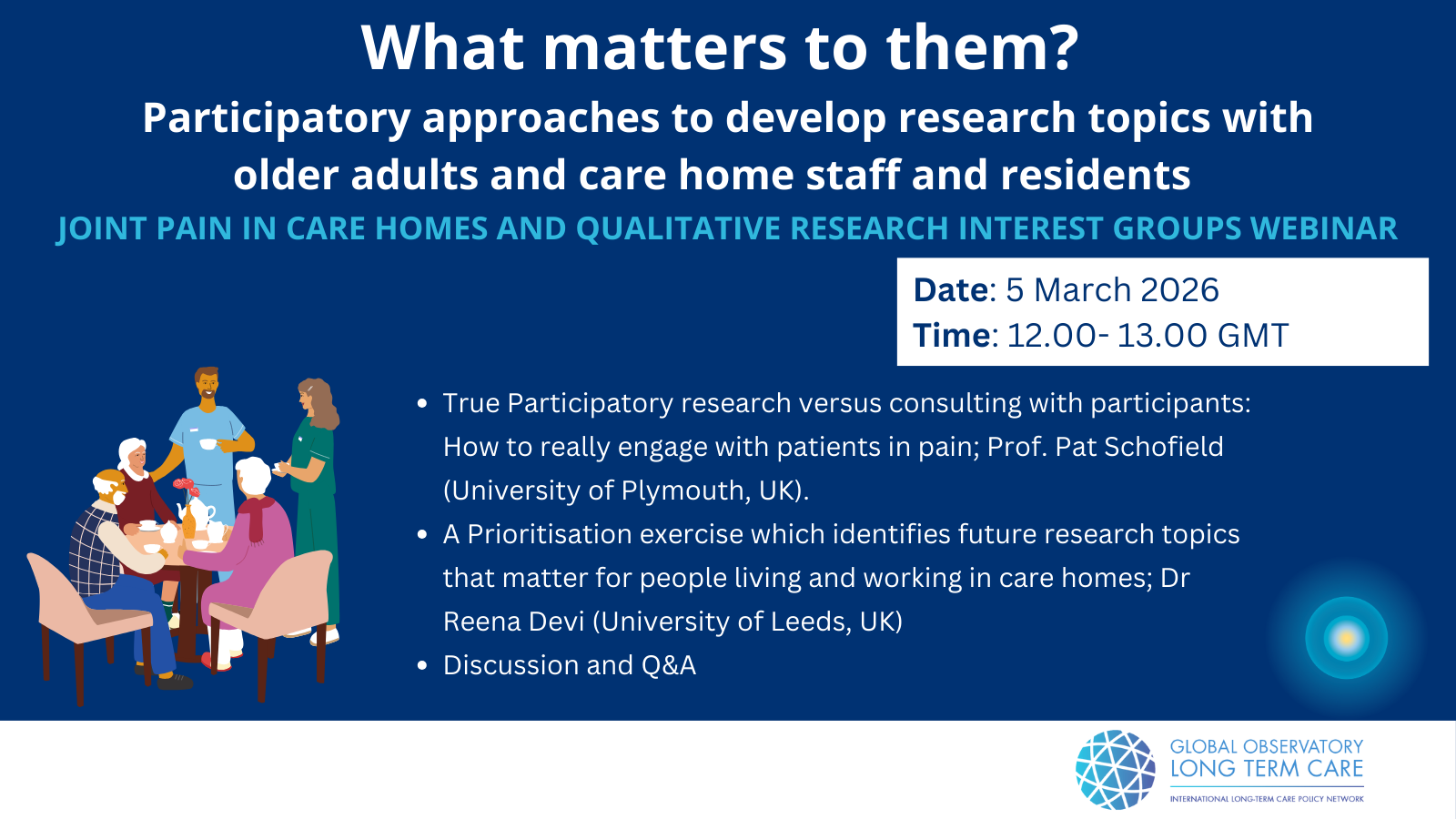
What matters to them? Participatory approaches to develop research topics with older adults and care home staff and residents
GOLTC Pain in Care homes and Qualitative Research Interest Groups joint webinar
Date: 5 March 2026
Time: 12:00-13.00 GMT, you can check your local time here
Link: register to join on Zoom
Pain management involves multiple components, including identification and assessment of pain, pharmacological and non-pharmacological interventions, ongoing management strategies, and evaluation of outcomes. Many people living in care homes experience dementia or cognitive impairment, frailty, and multiple co-morbidities, all of which can influence how pain is perceived, expressed, and communicated. As a result, pain can have a profound impact on their overall quality of life and wellbeing.
Participatory research offers a powerful way to involve experts by experience throughout the research process, putting their voices at the centre by exploring their lived experiences, priorities, and the changes they want to see.
This webinar will bring together the worlds of pain management in care homes and participatory research, highlighting how these approaches can work hand-in-hand to make a real difference. We will showcase how participatory research with care home residents can improve pain management in residential care and explore what it takes to create truly meaningful participation, ensuring residents are not just heard, but are in a position to actively shape research and practice.
The webinar will cover:
Introductions and welcome:
-
- Global Observatory of Long-Term care (Adelina Comas-Herrera, Care Policy and Evaluation Centre, LSE, UK).
- Pain in Care homes Interest Group (Dr Manuela Hoedl: Medical University of Graz; Prof Sandra Zwakhalen: Maastricht University, Netherlands).
- Qualitative Research Interest Group (Dr Chiara De Poli, Care Policy and Evaluation Centre, LSE)
True Participatory research versus consulting with participants: How to really engage with patients in pain; Prof. Pat Schofield, Professor of Clinical Nursing, University of Plymouth (UK)
A Prioritisation exercise which identifies future research topics that matter for people living and working in care homes; Dr Reena Devi (Associate Professor in Applied Health and Care Research, University of Leeds)
Discussion: Dr. Manuela Hoedl; Prof Sandra Zwakhalen and Dr Chiara De Poli, Care Policy and Evaluation Centre, LSE
Recommended reading:
Devi R, Haunch KJ, Graham EH, Griffiths AW, Hodge G, Clegg A, Drummond M, Forster A, Pearce S, Spilsbury K, Thompson C. 2025. The uncertainties and questions of care home residents, relatives and staff as a basis for evidence-based improvement and research. Age and Ageing. https://doi.org/10.1093/ageing/afaf125
Stewart, C., Thomas, N., Witton, R., McColl, E., & Schofield, P. (2025). Involving Family Caregivers in Developing an Intervention for Assessing Risk of Dental Pain in Individuals Living with Dementia. Geriatrics, 10(2), 35. https://doi.org/10.3390/geriatrics10020035
Wethington, E., Eccleston, C., Gay, G., Gooberman-Hill, R., Schofield, P., Bacon, E., . . . Meador, L. (2018). Establishing a research agenda on mobile health technologies and later-life pain using an evidence-based consensus workshop approach. The Journal of Pain, 19(12), 1416-1423. https://www.sciencedirect.com/science/article/pii/S1526590018303213
Schofield, P., Smith, B.H., Martin, D. et al. Systematically searching for and assessing the literature for self-management of chronic pain: a lay users’ perspective. BMC Geriatr 14, 86 (2014). https://doi.org/10.1186/1471-2318-14-86